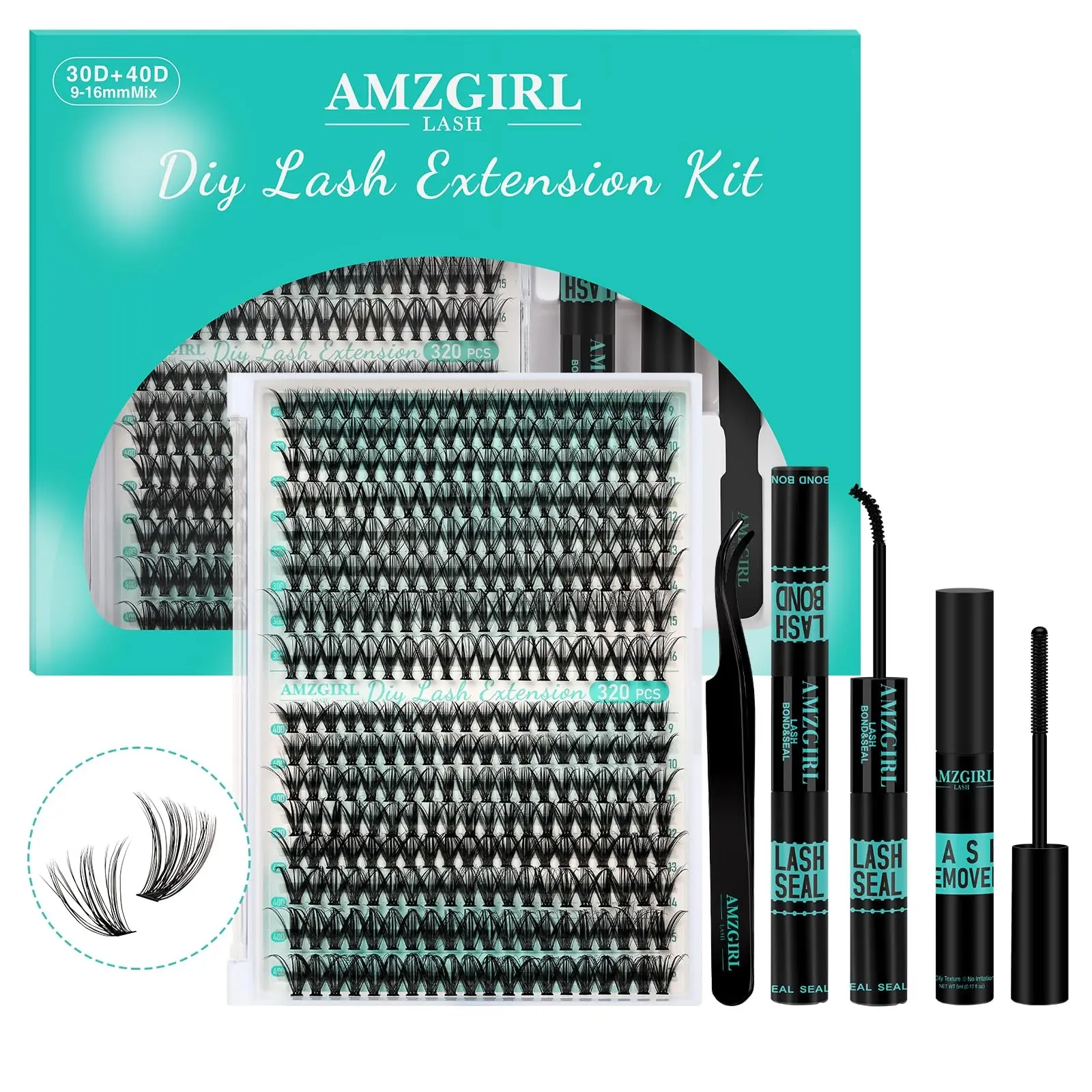
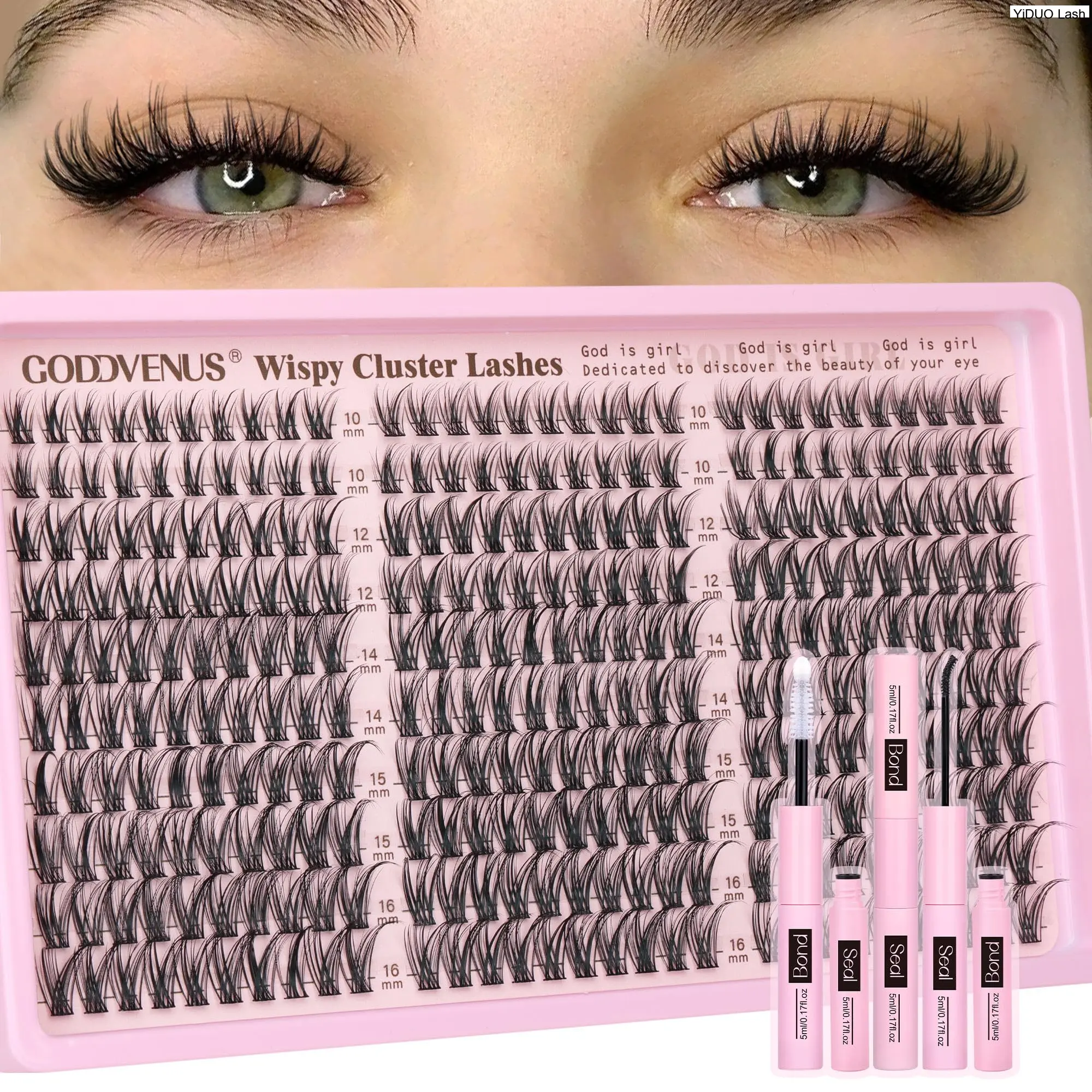
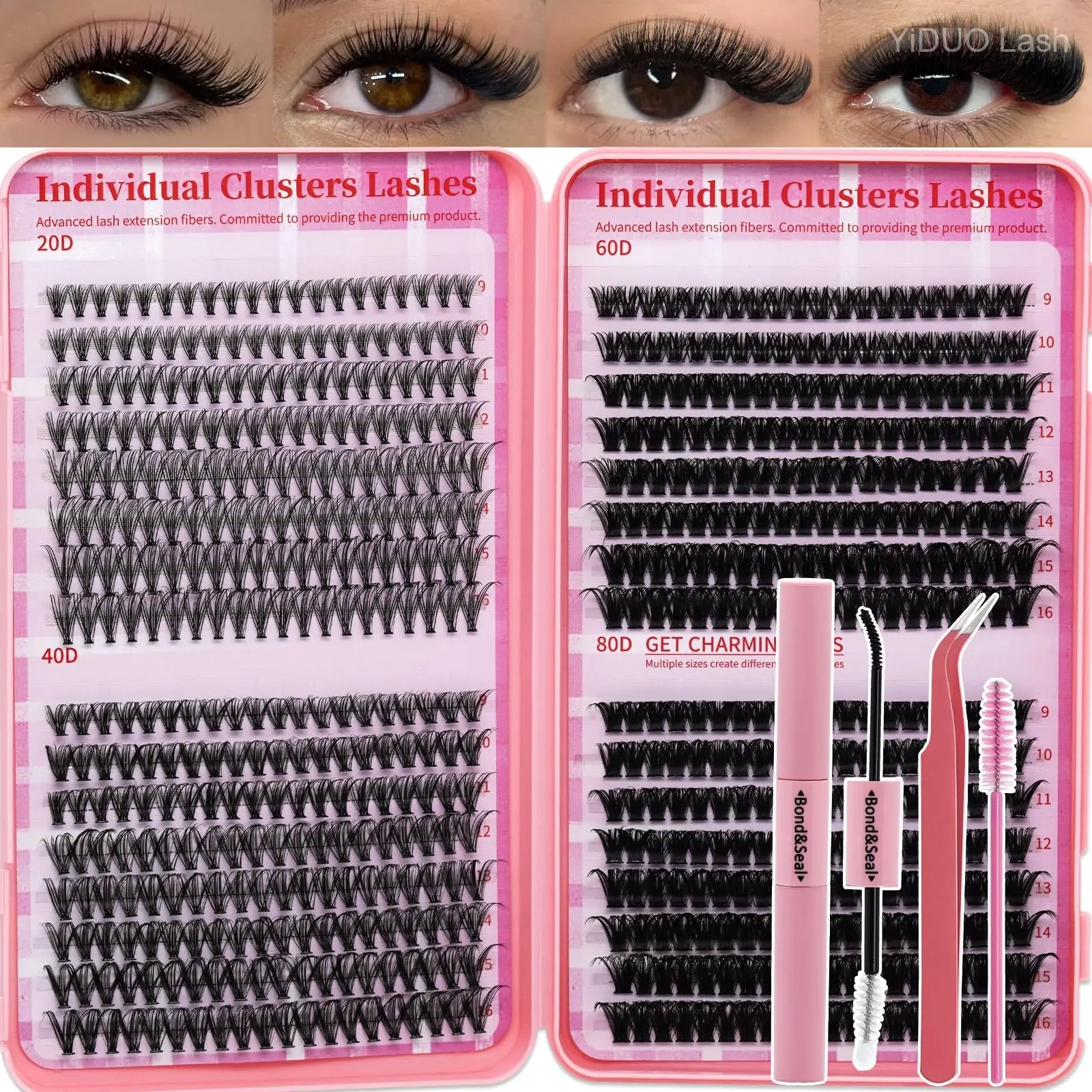
I have tried enough lash cluster kits to know that most of them overpromise and underdeliver — glue that burns on contact, bands thick enough to cast a shadow, and clusters that scatter across my pillowcase by morning. So when the RITALASH 640pc kit arrived — four distinct density styles in one tray, a bond-and-seal duo, tweezers, and a spoolie, all for under ten dollars — my expectations were measured. It took me less than ten minutes to finish both eyes, and I liked the result enough to skip mascara entirely. That hasn't happened with a kit in this price range before.
Inside the tray you get 640 clusters spanning four density tiers — 20D, 40D, 60D, and 80D — ranging from 9mm to 16mm in a C-curl. That gives you enough variety to build anything from a subtle outer-corner accent to full-volume drama. The thin band on these clusters is genuinely invisible once applied, which makes a real difference when you are aiming for that "are those extensions or did she win the genetic lottery" ambiguity.
How Long Do These Actually Stay On?
This is the question that makes or breaks any cluster kit. I applied a full set on a Monday morning using the included bond and seal. By Wednesday night, I still had every single cluster in place — no lifting at the inner corners, no gaps, no rogue lashes on my bathroom counter. I removed them before bed on day three because the bond was starting to feel tacky at the lash line, not because anything had fallen off.
The bond itself is a clear, lightweight formula that does not sting the way some cyanoacrylate-heavy adhesives do. I have accidentally gotten bond in my waterline with previous kits — a uniquely unpleasant experience where you spend the next hour blinking through tears while questioning your life choices. RITALASH's bond is far more forgiving. It has a thinner consistency that spreads evenly, and the seal locks everything down without leaving that glossy, perpetually-wet look.
That said, the "72-hour hold" claim on the packaging is realistic for sedentary days — office work, dinner, light errands. If you sweat heavily, swim, or rub your eyes, expect more like 24-36 hours before needing touch-ups. I wore these through a humid 85-degree afternoon at an outdoor market and one outer cluster started lifting by the evening. A quick dab of bond fixed it in seconds. For everyday wear, two to three days is the sweet spot — push past that and the glue residue builds up at the band in a way that is annoying to clean.
Is the Application Actually Beginner-Friendly?

Every cluster kit on the market claims to be "for beginners," but most of them require the steady hands of a neurosurgeon and the patience of a monk. What sets the RITALASH kit apart is the four-style density range — you can start with the lighter 20D and 40D clusters while you build confidence, then graduate to the thicker 80D pieces once your placement is consistent.
The under-lash application method — attaching clusters below your natural lashes rather than on top — takes practice no matter which brand you use. My first attempt with clusters (a different brand, months ago) left me with red, watering eyes and three crooked pieces after forty-five minutes of struggling. With the RITALASH kit, the thin band helps enormously. Applying the bond like light mascara — just tapping it along the base of the lashes — gives you the right amount of grip without overloading. The curved tweezer included in the kit has surprisingly good tension for a budget tool; it picks up clusters cleanly without launching them across the room.
One tip I picked up after my third application: leave a small gap at the outer corner before placing your first cluster. Placing clusters too close to the outer edge creates a droopy effect that drags the entire eye down. Start about two millimeters in from where your lash line naturally ends, and the lift stays crisp all day. Also, pinch each cluster against your natural lashes with the tweezers after sealing — that extra press really locks the bond and prevents the dreaded mid-day drift.
Are Lash Clusters Worth It Compared to Professional Extensions?
I have done both — professional extensions at $120 a set plus $60 fills every two weeks, and at-home clusters for a fraction of that. The honest answer: clusters win on flexibility and cost, extensions win on longevity and the zero-effort morning. Which one is "worth it" depends entirely on your lifestyle.
With professional extensions, I never had to think about my lashes — I woke up, splashed water on my face, and looked done. But the maintenance schedule was relentless. Miss a fill and you are walking around with gappy, uneven lashes until your next appointment. Over six months, I spent roughly $780. The RITALASH kit costs $9.88 and has enough clusters for at least 15-20 full sets. Even if you replace it monthly, you are looking at less than $120 a year.
The trade-off is that clusters demand ten minutes of your morning and a steady hand. They also do not look quite as three-dimensional as a skilled lash tech's work — clusters sit in a single plane, whereas extensions are fanned for depth. But from a normal social distance — across a table, on a video call — no one can tell the difference. And you can switch styles daily: natural 20D for the office, layered 60D+80D for date night. Extensions lock you into one look for weeks. Other 640pc options like the OLLAVO 640pc lash clusters kit match this one on piece count, but the RITALASH tray is the only budget option I have found that packs four distinct density tiers into a single purchase — which means you are not buying separate trays for everyday and going-out looks.
What Could Go Wrong — and How to Avoid It
Cluster lashes are not risk-free, and the biggest danger is damage to your natural lashes from improper removal. If you yank clusters off without dissolving the bond first, you will pull out natural lashes along with them. I did this once with an earlier kit and had a visible gap in my lash line for three weeks. The fix is simple: soak a cotton pad with oil-based remover (baby oil works, micellar water does not), hold it against the lash line for twenty seconds, and the clusters slide off with zero resistance. Do not sleep in them for more than two nights — the bond accumulates residue that becomes a breeding ground for bacteria, and I have heard enough stye horror stories to take that seriously.
Not every lash cluster style works for every eye shape. If you have hooded eyes or lashes that grow downward, the ultra-volume 80D clusters may feel heavy and look unnatural. Start with the 20D or 40D pieces on the outer two-thirds of the eye — that alone gives a lifted, defined look without overwhelming your features. Asian-brand clusters tend to use thinner bands and lighter materials, and the RITALASH bands lean in that direction, which helps with comfort on smaller or more sensitive eyes.
One more thing: the seal step matters more than you think. After placing all clusters and pressing them into your natural lashes, run the seal along both the top and bottom of the band. Skipping the seal is the number one reason clusters lift within hours. If the included bond runs out or thickens past the point of usability — which mine did after daily use — a standalone lash bond and seal set with better longevity is a worthwhile upgrade that costs less than a single lash appointment. Then go back and dab the tips of each cluster — the pointed ends — with another tiny swipe of seal. It sounds excessive, but that extra pass buys you at least another full day of wear.
The tweezers are not just for placement — pinching each cluster against your natural lashes after sealing is what locks everything into a single seamless line. Without that press, the clusters sit slightly separated from the lash base, which is what causes the obvious gap that reads as "wearing falsies" from the side. A firm pinch along the length of each cluster fuses the band to your natural lashes so they move as one unit when you blink.
Pros, Cons, and Verdict
Pros
- Four density styles in one tray — from natural 20D to dramatic 80D, no need to buy separate kits for different looks
- Thin, flexible bands that sit invisibly against the lash line
- Bond formula is gentle — no stinging or watering during application, unlike many budget adhesives
- The curved tweezers are genuinely usable, not the flimsy throwaway tools most kits include
- At under ten dollars for 640 clusters, the per-wear cost is negligible even if you replace them daily
- Removal is clean and easy with oil-based remover — no residue, no lash loss
Cons
- Not a true 72-hour hold for active days — expect 24-48 hours if you sweat or have oily lids
- The 80D clusters can feel heavy on smaller or hooded eyes
- Bond thickens in the bottle after about three weeks of daily use; budget for a separate replacement bond if you wear lashes every day
- Under-lash application still has a learning curve — your first attempt will probably not look like the product photos
The bottom line: The RITALASH 640pc kit is the best value I have found in the budget lash cluster space. It will not replace the luxury of a professional lash extension set, but at roughly 1/80th the annual cost, it does not need to. For anyone who wants the extension look without the extension commitment — and is willing to invest a few practice sessions to nail the technique — this kit delivers more than it has any right to at this price.
RITALASH 640pc 4-Style Lash Clusters Kit
Four density styles (20D-80D), bond and seal included — everything a beginner needs for DIY lash extensions at home.
View Product — $9.88Here is how the RITALASH kit stacks up on paper against what you would get from a salon:
| Product Specs | |
|---|---|
| Brand | RITALASH |
| Piece Count | 640 clusters |
| Styles | 4 (20D, 40D, 60D, 80D) |
| Length Range | 9mm – 16mm |
| Curl Type | C-curl |
| Band Type | Thin / invisible |
| Included Tools | Bond, seal, tweezers, mascara brush |
| Waterproof | Yes |
| Reusable | Limited — best treated as single-use for hygiene |
If you are on the fence between clusters and extensions, or between this kit and a pricier brand, start here. The four-style range means you can figure out what density and length actually suit your eye shape without buying four separate trays. And at this price, even if you only use it for special occasions, it pays for itself the first time you skip a lash appointment. If you prefer a spikier, more defined lash map, fairy lash clusters offer a manga-style alternative — but for versatile, all-in-one value, this kit is hard to beat.