I've watched friends buy lash clusters based on the package photo alone — and then wonder why their "natural" lashes look like stage makeup. The problem isn't the product — it's that nobody explains what the numbers actually mean. 30D vs 80D. C-curl vs D-curl. 8mm vs 16mm. Each of those specs changes how the lashes look on your specific eye shape, and picking wrong is why so many first-timers give up after one try. I've been there. The first set I bought made me look deranged. I didn't touch clusters again for six months.
There are four things that actually matter. That's it. Nail these and nobody will know you're wearing fake lashes. Screw them up and you look like you glued someone else's hair to your eyelids.
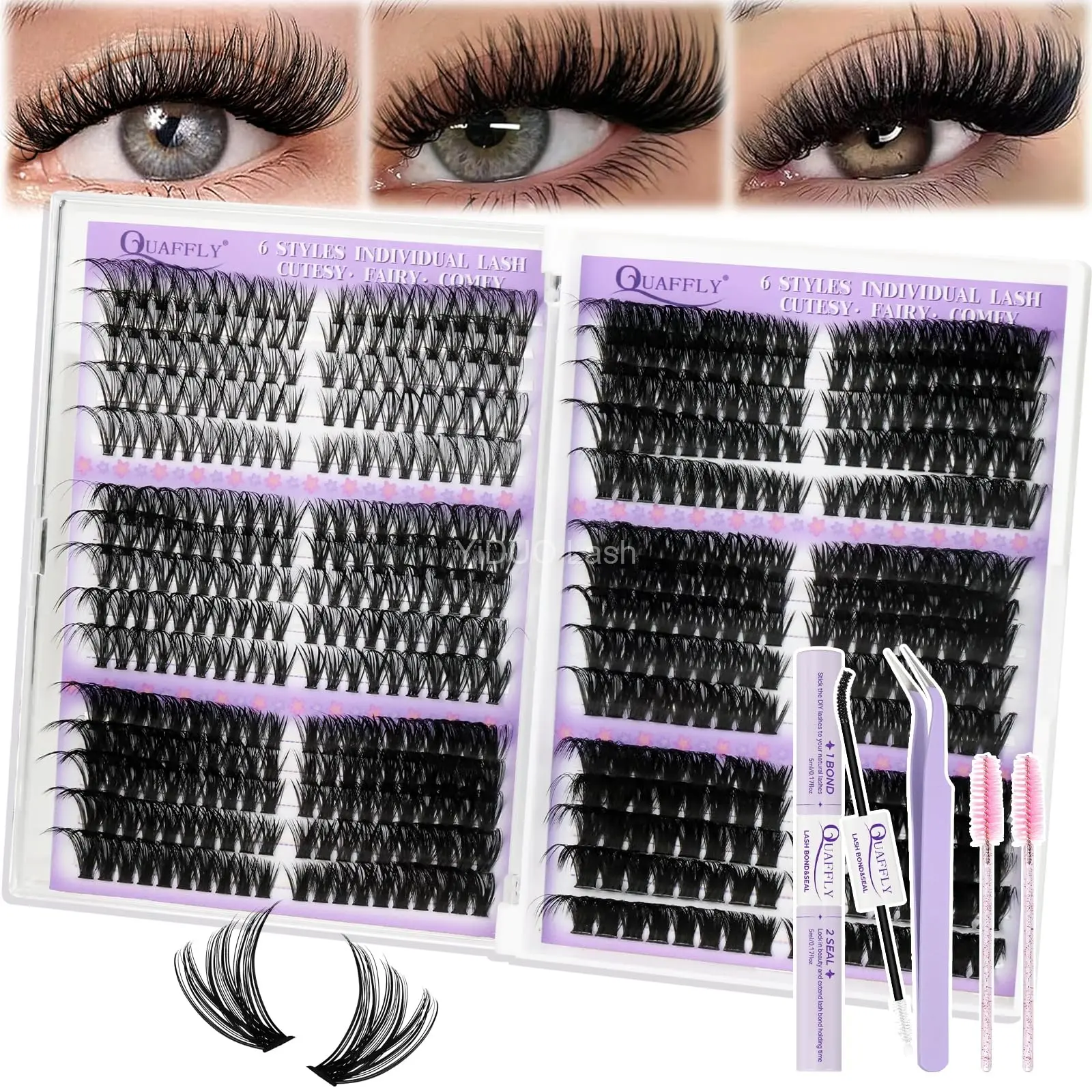
I'm using the QUAFFLY 570-piece kit to show examples here. It's ten bucks. It comes with six different densities in one box. I bought it myself, nobody paid me to mention it, and honestly for the price it's the easiest way to test everything without buying a separate kit for every style.
Curl — the thing that changes everything
Curl codes describe how much the lash fiber curves upward from the band. C-curl is the most natural — it follows the same gentle upward arc as real lashes. If you have naturally straight or downward-pointing lashes, C-curl lifts them without looking artificial. Honestly, I find C-curl a little boring unless you're going for the "I swear I'm not wearing anything" look. If you want anyone to actually notice your eyes, skip straight to CC.
CC-curl is slightly more lifted than C — about 15 degrees more upward angle. It opens the eye more visibly without crossing into dramatic territory. CC-curl is where most people land and stay: natural enough for daytime, lifted enough to make a difference in photos. If you've never worn clusters before and don't know where to start, CC-curl is the safest first purchase.
D-curl is the dramatic option — a pronounced upward sweep that's immediately visible. It's beautiful for evening looks, events, and anyone who wants their lashes to be noticed. Just keep in mind that if you have hooded or deep-set eyes, a D-curl might look a bit unnatural, almost like the lashes are pointing straight up toward your eyebrows instead of framing your eyes. D-curl also catches on sunglasses and overhead lighting more noticeably than C or CC.
Density — what all those D-numbers actually mean
The "D" number (30D, 60D, 100D) refers to how many individual lash fibers are in each cluster. A 30D cluster has roughly 30 fibers — it's light, wispy, and blends with natural lashes almost invisibly. A 100D cluster is three times as dense and reads as full, fluffy volume. Honestly, the categories overlap more than any chart will tell you. A 40D and a 50D look almost identical on the eye. Don't overthink it. Here is what those numbers actually look like in real life:
- 20D-30D: Think of this as your "no-makeup makeup" baseline. They're super light and wispy, making them perfect for filling in the inner corners of your eyes without creating a harsh, sudden block of dark hair.
- 40D-50D: The sweet spot for an everyday look. This density mimics a fresh salon set of classic extensions — noticeable enough to ditch mascara, but subtle enough for the office.
- 60D-80D: This is where you get into distinct "glam" territory. Stick these on the outer corners if you want a winged cat-eye effect, or map them across your whole lash line if you have an event and want your eyes to really pop in photos.
- 100D+: Mega-volume territory. Think festivals, heavy stage makeup, or photoshoots. Unless you are deeply committed to high drama every single day, don't wear these to the grocery store. They are heavy, they require a ton of bond, and they will feel like window awnings on your eyelids if you aren't used to them. I wore these to a concert once and one flew off during the encore. Learn from my mistakes.
The most versatile approach: 30D on the inner corner, 50D in the middle, 80D on the outer corner. This gradient mimics how natural lashes taper from thin (inner) to thick (outer), and it's the reason multi-density kits like the QUAFFLY 6-style are more useful than single-density sets.
Length — getting the millimeters right
Lash clusters are sold in mixed-length sets (8-14mm, 10-16mm, etc.) because real lashes aren't uniform. The shortest pieces (8-10mm) belong at the inner corner — placing anything longer there is uncomfortable and looks unnatural. The longest pieces (14-16mm) go at the outer corner to create lift and elongation.
For most eye shapes, a 10-14mm or 10-16mm mixed set covers all needs. If you have small or hooded eyes, lean toward 8-14mm — the shorter maximum length won't touch your brow bone or hood. If you have large or wide-set eyes, 10-18mm gives you room to play with length without the clusters looking disproportionately short.
Bands — why clear is the only way to go
The band is the horizontal strip that connects the lash fibers. Clear/invisible bands are the modern standard for a reason — they disappear against your lash line and don't require eyeliner to hide them. Thick black bands belong to traditional strip lashes and look obvious unless you're wearing heavy liner. Thin clear bands on clusters applied under the lash line are genuinely undetectable from more than six inches away.
The QUAFFLY kit uses thin clear bands across all six styles, which is what you want for under-lash cluster application. If you're using clusters on top of the lash line (the traditional strip lash method), a slightly thicker band is easier to handle but won't look as natural.
How to Find Your Style Without Wasting Money
The best way to figure out what works for your specific eye shape is to test multiple styles on the same eye. Apply a 30D C-curl cluster to the inner corner, a 50D CC-curl to the middle, and an 80D D-curl to the outer corner — all on one eye. Step back, look in a mirror from three feet away (conversation distance), and note which density and curl reads best. Then do the other eye with your favorite combination.
This is why a 6-style kit is the right first purchase. A single-style kit commits you to one look before you know what works. A multi-style kit is a sampler — use it to test, then buy more of the specific style you liked best. At $9.99 for 570 pieces across six styles, the cost per test is essentially zero.
For most first-timers, the winning combination is 40D-50D CC-curl in 10-14mm with a clear band. That combination reads as "great lashes" rather than "fake lashes" on the widest range of eye shapes and face types. Once you're comfortable with that, branch out to D-curl for events or 30D for truly invisible daytime wear.
QUAFFLY 6-Style 570pc Lash Clusters Kit
Six densities in one box — natural through volume. Clear band, C/CC/D curl mix, bond & seal included.
View Product — 9.99 USDOnce you figure out your ideal curl, density, and length, buying clusters gets so much easier. You won't have to guess what's inside the box anymore — and you can just grab whatever brand or applicator you happen to like. Just don't forget that even the most perfectly styled clusters won't make it past day two if you skimp on a solid bond and seal kit.